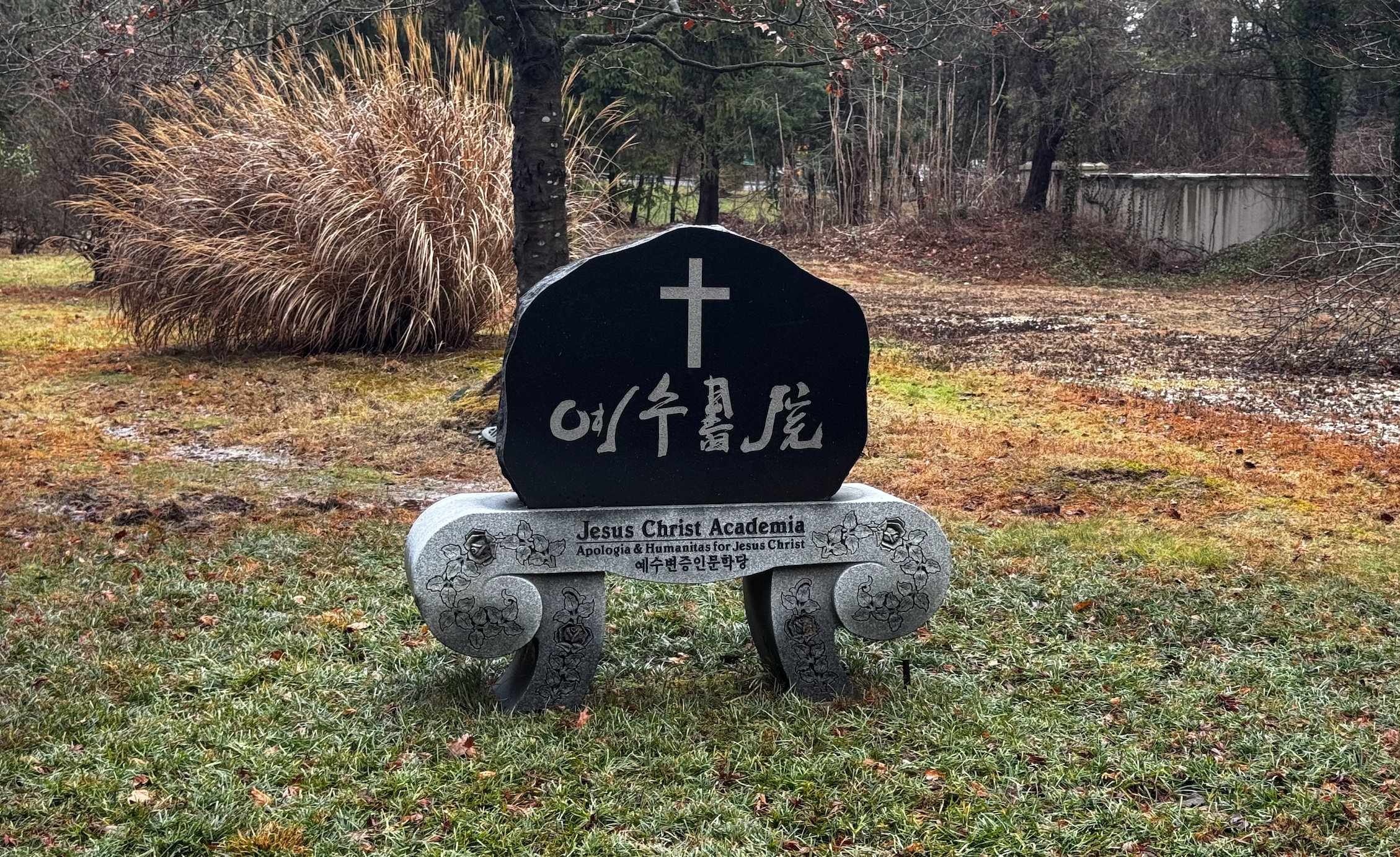
🏛️ Jesus Academia Part 3
(Part one is here; Part two is here)
Last time, we explored (in the form of “stories”) the sublime Jesus that Paul encountered, the life of Pastor Ko, who went all in for that same Jesus, and finally the life of Thomas Aquinas. As promised, the final part of the Jesus Academia review will begin with the story of Beethoven.
“I am Beethoven!”
Ludwig van Beethoven is one of the figures whose life was radically changed by encountering the sublime Jesus Christ. He embodied the truth of “When filled with Jesus, this world becomes as excrement,” a truth he expressed through his music.
Though Beethoven left few writings, his thoughts and struggles can be traced through his music and letters. (For a deeper understanding, Pastor Ko recommends Romain Rolland’s book Beethoven.) Below is a beautiful testimony crafted by Pastor Ko, based on Rolland’s work.
On October 6th, 1802, in a small cabin in Heiligenstadt, Beethoven wrote a letter of farewell, “the Heiligenstadt Testament”. After six years of despair, he could no longer bear it and decided to end his life, leaving a letter for his beloved siblings. His struggles with various illnesses, four heartbreaks, and the shocking diagnosis of deafness led him to write:
“Nothing but death can free me… Music was my only lifeline, and now, to a musician, deafness—such an unfathomable contradiction…”
However, just four days later, on October 10th, Beethoven wrote a completely different note, one full of hope and resolve:
“Father God! I shall not die! Grant me the joy of life!”
What happened in those four days to cause such a change in Beethoven? Pastor Ko posits that during his four days in Heiligenstadt, Beethoven had a mystical encounter with Jesus, particularly the Jesus who suffered in the Garden of Gethsemane.
On 5th April 1803, following his time in Heiligenstadt, Beethoven composed (in just 14 days!) Christus am Ölberge (Christ on the Mount of Olives), an oratorio depicting the biblical scene of Jesus praying in Gethsemane before his arrest. Pastor Ko connects the emotional intensity of this work with Beethoven’s own spiritual experience in Heiligenstadt, seeing it as a profound artistic expression of his encounter with the sublime Jesus.
Pastor Ko believes this oratorio marks a turning point for Beethoven. The act of composing it began his journey of spiritual recovery. Beethoven composed some 722 pieces throughout his life, much of it after 1803. Beethoven’s artistic output following this period—particularly his later symphonies and string quartets—demonstrates a spiritual transformation, transcending the ordinary (suffering) into the sublime. Beethoven no longer sought to escape suffering but found deeper meaning within it, which is reflected in his greatest works.
Piano Sonata No. 32 in C Minor, Op. 111 (1822)
The first movement is dramatic and intense, reflecting Beethoven’s inner turmoil, while the second, with its mystical theme and variations, represents his transcendence. This sonata reflects his transformation from suffering to spiritual peace, embodying his journey towards redemption and the sublime.
Symphony No. 9 in D Minor, Op. 125 (“Choral”) (1824)
The final movement of Symphony No. 9, with its Ode to Joy, marks the pinnacle of Beethoven’s spiritual journey. This symphony is a declaration of joy, universal brotherhood, and the transcendence of suffering, representing a shift from personal despair to a glorious vision of hope and unity.
String Quartet No. 13 in B-flat Major, Op. 130 (1825)
The Cavatina movement expresses deep sorrow, while the Grosse Fuge (originally the finale) is a powerful declaration of victory. This quartet represents Beethoven’s emotional and spiritual elevation, from anguish to a majestic resolution, epitomising his growth towards the sublime.
Pastor Ko sums up Beethoven’s music as “music that embodies sublimity itself, overflowing with simplicity, purity, and power.”
There are two anecdotes that vividly illustrate Beethoven’s “fullness of being.” The great contemporary genius Goethe visited Beethoven in his town. As they walked down the street, people recognised them and showed respect, lifting their hats and bowing. Beethoven, with humility—not arrogance—convinced Goethe that it was he, not Goethe, to whom the people were showing reverence. Another time, as they walked by royalty, Beethoven didn’t step aside. Instead, he walked straight ahead, forcing the royals to step aside and pay their respects. Beethoven famously declared: “I am Beethoven!”
Just two days before his death, on March 24, 1827, Beethoven proclaimed, “Applaud, my friends, for the comedy is finished (Plaudite, amici, comoedia finita est)—the comedy of a life that moved through suffering and into joy.” Indeed, Beethoven’s life and music exemplify a journey through hardship that ultimately leads to triumph and joy.
In a word, Beethoven lived a truly magnificent life. His life’s testimony is an invitation for us to enter into the sublime through “gaining Christ and be found in Him”—Yeshua of Nazareth, the Cosmic Creator God. Together with Paul, we too then will be able to say, “Yet indeed I also count all things loss for the excellence of the knowledge of Christ Jesus my Lord, for him I have suffered the loss of all things, and count them as dung, that I may gain Christ.”
Blessed assurance, Jesus is mine!
Oh, what a foretaste of glory divine!
Heir of salvation, purchase of God,
born of his Spirit, washed in his blood.Perfect communion, perfect delight,
visions of rapture now burst on my sight.
Angels descending bring from above
echoes of mercy, whispers of love.Perfect submission, all is at rest.
I in my Savior am happy and bless’d,
watching and waiting, looking above,
filled with his goodness, lost in his love.Fanny Crosby (1873)
Learning the Secret of Conatus
Pastor Ko, who has mastered the classical Western canon of philosophy and literature, clearly distinguishes between the “human condition in the state of original sin” and the “human condition as a new creation, transformed through the work of the Holy Spirit.” He even brought in German terms like Das Sein, Das Seiende, and Da Sein to elaborate on these ideas. However, as a “techie nerd” who majored in physics, I must admit that I found this part a bit challenging to grasp. Nonetheless, there was one key insight that I gained from this part of the lecture: it was Spinoza’s concept of Conatus.
In fact, even before attending Jesus Academia, I had encountered the concept of “Yetzir HaRa” (יֵצֶר הַרַע) from ancient Jewish tradition while researching the satanic roots of leftism and communism. This concept, which roughly translates to “evil inclination,” stands in contrast to Yetzir HaTov (יֵצֶר הַטוֹב), meaning “good inclination”. However, the concept of Yetzir HaRa does not exclusively refer to “evil inclination,” as explained in ancient Rabbinic tradition. According to this tradition, when God first created humanity, He endowed them with only good intentions, devoid of Yetzir HaRa (the evil inclination). The story goes that, created in this way, humans were fully content with everything and lacked any creative drive, ambition, or desire for achievement. This particular story left a deep impression on me. I remember thinking that Yetzir Hara not only resonated with my understanding of human nature, but also corresponded well to my observations of the world. It wasn’t just an “evil inclination” but something that is vital to abundant life and a necessary tension and drive that motivates human endeavour and creativity.
During this session of Jesus Academia, I encountered a concept very similar to Yetzir HaRa, called Conatus. This concept is akin to Nietzsche’s “will to power” or even Carl Jung’s “libido” (other terms like “mojo” or “drive” also come to mind). Pastor Ko defines it as: “Conatus is the drive to maintain one’s own identity.” Whether we are the old self, trapped in original sin, or the new creation, transformed through the Holy Spirit, the fact that Conatus exists within all of us, driving progress, is a profoundly important insight. What is especially crucial for Christians is that, as we live out the principle of love, we must use the language of “praise” to encourage and nurture each other’s Conatus. Pastor Ko emphasised that this practice of regular praise is especially vital for those closest to us. Pastor Ko practices what he preaches: heaping daily praises to his wife with a true heart—and everyone attending Jesus Academia could clearly see that Mr. and Mrs. Ko are very much still in love with one another.
Coming from a family with deep roots in Gyeongsang Province—Eastern part of South Korea infamous for its Confucian, male-dominated conservatism—this teaching was truly transformative for me. Reflecting on the past generations, including my grandfather and father, I realised the “generational curse” of being “stingy with praise” towards my family members. In particular, our family culture esteemed day-ui-myeol-chin (大義滅親)—the idea of sacrificing familial emotions for the greater cause—as a virtue. As a result, I came to see how I had failed to express love to my own family, and I was deeply convicted by this realisation.
Below, I would like to quote the “11 Miracle Phrases for Building a Happy Family” from the book “Fool, the Real Game is in the Second Half” (Du Sang-dal, Kim Young-sook, 2023):
- “Honey, it’s tough, isn’t it? You’ve worked hard.” [Consideration]
- “I have no one but you.” [Reliance]
- “I believe in you. Hang in there.” [Respect]
- “I’m proud of you.” [Encouragement]
- “Do what you think is best.” [Trust]
- “It’s okay, it happens.” [Acceptance]
- “You must have had a hard time with the kids all day.” [Understanding]
- “Your cooking skills are the best, just like your mother’s.” [Compliment]
- “I love you. I’m happy to be with you.” [Love]
- “It’s my fault. I’m sorry. Please forgive me.” [Forgiveness]
- “You’re beautiful. I love you. You’re amazing.” [Affection]
After attending Jesus Academia, our whole family spent two days sightseeing in NYC. During this time, I decided to put into practice what I had learned and experiment using “words of praise that ignites Conatus” with my two sons. For instance, even in situations where I would typically give a scolding, I tried saying things like, “When I was your age, I did this, but I see that you’re already so much smarter and more impressive. I’m actually proud of you!” And something truly amazing happened. Right before my eyes, it was as if flowers were blooming in real time, watching my sons’ faces light up. After that, they continued to be in high spirits, brainstorming ways they could make me even happier, and in that moment, my heart was filled with joy.
Reflecting on this, I was deeply convicted in my heart. I reflected on how I had mostly been quick to anger with my sons and had often failed to offer enough praise. I made a firm resolve that from now on, I would change my language habit and strive to be a good father who continually sparks their Conatus. That evening, as we sailed past the Statue of Liberty, watching the sunset, I silently made this promise to myself.

Meeting My Mentor
As those who have read the three-part reflections of Jesus Academia will know by now, I am so grateful to God for having met Pastor John Ko. He has become a mentor I deeply admire, a true senior in life who is exactly twice my age, and someone I aspire to emulate. Not only is he humble and a lifelong learner, but most of all, he has shown me, through his life, how profoundly sublime, abundant, and beautiful a life can be when it is fully devoted to loving Jesus Christ alone. My desire is to continue to learn from him, serving him as my teacher, until the day our Lord returns.
If I may humble brag, I was overjoyed to discover several similarities between Pastor Ko and myself. For instance, I have always cherished the Revised Korean Bible (full Chinese Characters version), which I bought in 2011 as a wedding gift to myself. I was truly delighted to find that Pastor Ko uses the same Bible (I had never seen anyone else use this version). Beyond that, I found common ground with him in many aspects: our shared interests in Chinese calligraphy and photography; a raw spirituality rooted in loud, “crying out” prayer; an unwavering persistence in mastering a single subject; a special passion for apologetics; a generous and noble character that genuinely celebrates the success of others; and last but not least, a strong anti-communist spirit. I was so happy to discover these areas where I deeply resonated with Pastor Ko.
“How wonderful it would be if, by the time I reach 80, I can live a life like Pastor Ko’s, having dedicated myself to consistent reading, study, and the accumulation of wisdom!”
In Conclusion
Even after this three-part reflection, I feel that I have only scratched the surface of what I’ve learned during the week at Jesus Academia. In this final part, we explored the story of Beethoven—how he encountered the sublime Jesus amidst suffering and how his music became a tribute to God’s providence, elevating his suffering into sublime beauty.
As I was reflecting on the incredible teachings and love experienced at Jesus Academia, one Bible verse kept coming to mind: the last verses of the Book of Acts:
“Then Paul dwelt two whole years in his own mansion and received all who came to him, preaching the kingdom of God and teaching the things which concern the Lord Jesus Christ with all confidence, no one forbidding him.”
Acts 28:30-31
After experiencing Jesus Academia in Pastor Ko’s beautiful home in Long Island, my wife and I were also inspired by a vision. We hope to establish a space like “Jesus Academy London,” where we can welcome all who come to us, preach the Kingdom of God, and boldly teach all things concerning our Lord Jesus Christ while raising disciples.
We believe that the return of our Lord Jesus Christ is near. As the darkness of this world deepens and the love of many grow cold in these End of the End of the End Times, the light of the Gospel must shine ever more brightly. When we align our desires with God’s will and open our mouths wide, we believe that, in His perfect timing, the God of the universe will faithfully provide everything needed to fulfil this vision. Our calling is to live out and share the Gospel here and now, with faithfulness, boldness, and joy—just as Beethoven showed us through his music, and Paul through his life.
Maranatha! Come, Lord Jesus!